Tuesday, March 17, 2015

Cart Boundary Stake System

Have you ever noticed around greens or tee boxes that there are areas where there just isn’t any grass?  Maybe next to where everybody parks to walk up to the green? Or where everyone drives onto the fairway from their tee shot?  There is a solution for these cart stressed areas.  We have been working in the shop during the inclement weather times getting this stake system fabricated and we are now ready to put it in action.
4x4x18" posts - one of them placed near cart path and other on other side of fairway
 As you come out to play the courses this week you will notice these large wood stained 4x4 posts (18" tall) with either blue or red painted on the top on all par 4s and 5s on both courses.  The blue ones will be on the Cypress Course to go along with the blue flags, and the red ones will be on the Pecan Course, as it has red flags.  These stakes will be indicators for all carts to let you know where to enter and where to exit each hole with your cart.  There will be one placed just after the tee boxes and two of them up near the green on each side of the hole.  From the tee box you will need to keep your carts on the path until you drive PAST the marker and then you are free to drive anywhere on the hole until you get to the two stakes near the approach to the green, at which point you need to get back on the cart path BEFORE PASSING them.  Due to the shortness of the par 3 holes we are going to designate them Cart Path Only at all times, and there will not be any markers. 
 
You can see from these simple drawing diagrams what is the correct and incorrect ways to drive near the stakes. 

Past tee boxes - one stake near cart path - you can see from the arrows where you are allowed to drive - always go past the stake before entering fairway - imaginary dotted line horizontally from the stake and cart path

Near green - imaginary dotted line across both stakes showing where you are not allowed to drive

There has always been a large number of members at my previous clubs who pleaded with me to get this done to help the turfgrass around the high profile areas (tees and greens), and it works great provided we get membership buy-in.  We will rotate the location of these markers on a daily basis so we can spread out the traffic, but they will always be roughly 25-100 yards from the green.  This will allow the roughs around the tees and greens to grow without the additional stress.  It will give them a fighting chance to be the best looking grass on the course, which is what you would want and expect around your best areas.  We also have the smaller 8" wooden stakes along the cart paths near greens and tees protecting areas where carts park to walk up to these areas. 

Now that these markers are up and the stress is taken off, we will begin the recovery and healing process around these areas.  We will do some solid tine aerification to relieve the compaction that heavy cart traffic can cause, and then follow up with some needed fertility and deep watering to get the plant back to recovery.  It is work that you won’t really notice as a golfer, but the benefits will be very nice. 

We want to make your round as enjoyable as we can from an ease of access perspective as well as a quality of conditions perspective.  We feel these new guidelines will fit right in with both of those.  We can’t do it without the help of our membership.  We will also make announcements prior to golf outings letting them know the cart rules as there is a good bit of traffic from those groups.  Thank you for your understanding and help in spreading the word.  In order to make these courses the best they can be it is going to take more than just effort on the course maintenance staff to get it done - everyone can participate and help in the cause by leaving the course in better shape then you found it. 


Monday, March 9, 2015

New Golf Course Flags

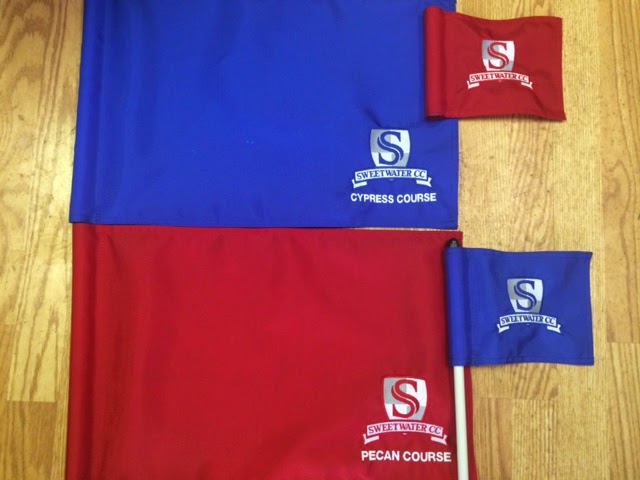
One nice little change that you will see this week on both golf courses – a different look to the flags on each hole.  We went with a more classic style look and a little differentiation between the two courses. You will see blue flags on the Cypress Course and red flags over on the Pecan Course.  Not all that earth shattering, but just a little something to put some separation between the two.  It even says the name of the course embroidered on each flag underneath the embroidered logo.  We also made little putting green flags in blue and red with the course logo instead of the plain white flags.  We will continue to use the white flag sticks with yardage reflector.  Just another small step towards improving your experience here at Sweetwater. 

New Flags with course name below logo


New Tee Markers and Cart Path Stakes

The weather hasn’t exactly cooperated much with us over the last month, but that isn’t slowing us down from getting ready for spring.  There are a number of projects that we have been working on and cleaning up some of the course accessories is big on our list.  One of my first impressions when I started a month ago was that a lot of the course accessories (tee markers, stakes, rope, flags, ball washers, flags, etc.) didn’t match or have any theme to them.  Sometimes the accessories on a golf course can make or break you, and leave the member or guest with a bad impression of the place.  I’ve always tried for a simplistic, classic look with course accessories – you don’t want the accessory to overpower the course, let the architecture do the job. 

Tee markers were in need of a change, as it had been a little while since the last ones were done.  We decided the best thing to do for now was recreate what had been used, but give it an upgrade so it would last longer.  All landscape timbers were angle cut, sanded, stained, and painted for completion.  The stain waterproofs the wood to prevent moisture damage, and also has a protective coating to prevent mildew buildup which was an issue with the old ones.  It should also give it a new, fresh look that lasts much longer.  We will redo tee markers every winter.  We put the new ones out this past weekend.
 

Sanding down the tee markers for smoothness
 
Staining them for water and mildew prevention
 
Painting the edges for each tee box location
 
Blue tee markers in place

One other thing that I saw as an opportunity to spruce up the place and improve grass conditions was to make new wear area stakes.  With any golf course that uses golf carts for the players you are always going to have areas where the grass gets worn down.  I’m sure you saw a bunch of the little green and white stakes all over the place that prevented you from driving in certain areas.  I have used those at my previous courses, but I thought this place might be better suited to stay with the wood theme.  We took the same material we use for tee markers and cut them straight at 8” and added a 3/8” galvanized stake to keep them in the ground.  These stakes were also sanded and stained with the same material used for tee markers.  We will use these around tees, greens, and high traffic spots around cart paths.  I would prefer to never use any type of stake, but I feel it is necessary if you want to have grass in all areas.  We need the help of the membership to obey the areas where there are stakes and not drive through them.  We will straighten these daily and move them around to areas of need as we see fit.  We started putting these out last week. 

Staining wear area stakes
Placement of wear area stakes along cart path near a green where carts park

Once these are complete we will move on to a few other things, including painting all hole signs and ball washers. We will also create a boundary system around tees and greens to try and minimize unnecessary traffic around these important areas to improve the aesthetics and playability of some of our most important grass areas.  I’ll talk about this more in depth next week once the stakes are ready to go.  They are in addition to the little stakes used around cart paths. I’ll talk about their importance and what we will do agronomically to get grass back in a lot of these areas.   

Friday, February 20, 2015

Spring Home Lawn Care

Spring time is a crucial time for golf course managers to make sure they get their grasses started off on the right foot.  It is also just as crucial for all of us homeowners if you want that lawn that all of your neighbors are envious of.  There are many steps you can take to ensure that you are doing everything to give it that advantage.

As soil temps start to warm up and the amount of sunlight in the day starts to increase the grass is going to want to green up.  We need to take some steps to maximize both the amount of light that reaches the soil and the temperature of the soil.  The more light that hits the soil, the more heat that will reach the soil – makes sense.  The biggest step we take in the golf industry to maximize this is to scalp off the excess dead, dormant material (brown grass) to allow for new growth and more sunlight.  That brown stuff can get pretty thick, especially with the harsh winters we have had as of late.  If left alone it will just shade out the soil and slightly delay that green up effect.  The scalping is a one-time deal – do not leave the mowing height at that low height after this is done.  Typically, I will lower our mowing heights from 25-50% below the height of cut that you use during the growing season – it just depends on how thick your turf is.  Don’t go from 3” height down to dirt level – that won’t help anything.  If you mow your St. Augustine at 2.5”, I would lower the height to around 1.5-1.75” and start there.  You can always lower the height again if you feel it needs to be lower.  Just remember you’re not looking to take off all of the brown material, you’re just trying to give the plant some room to grow.  You also want to do this before the grass really gets growing so you are removing more dead material then viable, green material.  I always shoot for around the first of March, especially if trees are greening up and budding. 

One important thing most homeowners forget is to take care of your machines that maintain your grass.  I know I’m nothing as a superintendent without my equipment staff.  It might be the most critical part of turf maintenance.  The biggest thing is keeping a sharp blade.  The mowing process is stressful to turf, even with a sharp blade, don’t make it worse by using a blade that is as dull as your finger.  I see so many homeowners that end up with weedy, thin yards, simply because they mow to low, don’t mow often enough, and mow with super dull blades.  Might as well just put rock in your yard and go desert style, because you ain’t growing grass!!  It’s pretty simple – one bolt to remove the blade, take it off and use your bench grinder to sharpen the blade only on the angled side.  If you need help with this just bring it to me and I’ll show you here at our shop.  If you don’t want to sharpen it, go buy a new one.  Trust me, the $20 to get one will pay for itself in turf quality.  I like to sharpen mine at least 2-3 times per year. Use the winter time, when you aren’t using the mower to go through the rest of the machine – change the oil and air filter, pressure wash it, etc.  Get it in prime condition because you know once the summer comes you won’t have time for that. 

After your grass gets a nice scalp down and is ready for growth this is a good time to get your spring preemerge and fertilizer out to protect it from spring weeds and give it the nutrients it needs to get growing out of dormancy.  Scott’s Bonus S is a great product and one that I use at home.  They make it easy for homeowners.  It does have some post emergent effects on weeds (meaning it will kill weeds that are already there), but it is mostly used to help prevent weeds from coming up. Read the label carefully before application!! If you don’t get the product out evenly you might as well not even use it.  Get it watered in and washed down to the soil and off the leaf blade.  You can time it with an upcoming rain (although not a heavy washout type rain). 

Taking these steps will help ensure that your lawn gets the advantage it needs to be lush and green this spring/summer.  For those of you that have someone take care of your lawn, don’t be afraid to ask these same questions to the guy in charge.  Trust me, they will take whatever short cut they can to maximize their profit and they may not do all of these things, especially if you as the homeowner don’t know yourself what needs to be done.  If you have any questions about this part of lawn maintenance or any other please don’t hesitate to give me a call or stop by.  I’m here to help!!

Tuesday, February 17, 2015

Spring Preparation

Soil temps will be warming up soon and with that brings green grass.  With the air temps in the 70s over the last few weeks you can already start to see some leaf greenup, although we are a long way from the plant actually growing actively.  Our goals at this time are to condition the surfaces to be ready and primed for the spring.  There are a number of steps to take to get there. 

Closeup look at the blades that penetrate the ground
First, in order to relieve compaction that has accumulated over the late summer – winter and to promote spring root growth and development, we will be slicing and solid tine aerifying the roughs and key walk up areas.  With all of the cart traffic in the roughs over the winter this is a much needed step towards keeping our roughs nice and full every year going forward.  The slicing device that we use is called an Aerway (tractor mounted slicer) and it creates a 4-5” slit on the surface and goes down about 4-6” in the ground.  This slicing action opens up the canopy for water infiltration and fractures the ground to promote air movement to allow for deeper root growth and healthier turf.  This is a perfect time of the year for this action.  Even though the grass or top portion of the plant is not growing yet, the temps are in perfect range for root growth.  Around key areas where we get the most traffic, like green surrounds and walk ups to greens and tees, we will be using our solid tine fairway aerifier, in addition to the Aerway, to get a little more relief.  This process is not invasive at all and can be played on right behind.

The look of the grass after process is complete
Second, we will follow these cultural processes with our annual scalp down.  We will take the roughs down from their usual 2” height to roughly 1.25-1.5” to remove all of the dead/brown material.  This action allows for sunlight down to the soil and gives the new grass plenty of room to grow uninhibited.  Allowing more sunlight to the soil will actually increase the soil temperature as there is less material to shade it.  The mowing behind the slicing will help smooth out the slits and give the surface a nice clean appearance.  If we can start with a clean slate for the spring it will make our growing season easier and allow for better results.  We will try to complete these tasks in the month of February, weather permitting. We have already started the process on the Pecan Course, and should have it wrapped up by the end of the week so we can start Cypress next week. 
Scalping down the turf behind to smooth out surface and remove dead brown material

Lastly, all of the processes are done ahead of time to get ready for the spring pre-emerge and fertilization of all grass surfaces during the middle of March.  As you know, a pre-emerge is designed to provide a barrier or barricade for weed growth on the soil surface.  Slicing the ground or any surface disruption can negate the effects of this, so we go ahead and get all of that done beforehand for the best results.  The fertilizer will give the plant the much needed nutrients that it needs for new development. 

We are also busy trying to finish up a number of winter projects.  There are a number of dead trees that we have removed and will continue to remove as well as the continuation of trimming trees for better tree and turf health. We are also working on some small details that you should start noticing, like edging sprinkler heads and sprucing up the practice area experience.  We want to get most of the projects wrapped up before the Spring so when the grass starts growing we can be ready to keep up with it.   

We look forward to a great 2015!  I will be communicating with you a lot throughout the year, so if I didn’t get to all of the topics out there, I will very soon. As always, if you have any questions or comments about the courses please feel free to get in touch with me.  We are always looking to do our part to improve your experience. 

Wednesday, February 11, 2015

Introduction

I hope this is one of many letters that I will be writing you guys over the coming years.  My name is Randy Samoff, and I’m the new Golf Course Superintendent here at Sweetwater.  I am extremely excited to be here at this awesome club.  I’m a native Houstonian, growing up in Baytown, and I’m also a graduate of Texas A&M.  I have a lot of experience in the Houston area, spending a total of 16 years at clubs like Champions, Redstone, and The Woodlands.  I’m excited to get the opportunity to provide conditions that you will all be proud of. 

I fully believe that communication is a key and integral part of my job and I will be doing a lot of it with you guys through various media once I get set up (look for more info in the next month).  I will be writing articles like this on a monthly basis that will be included in the newsletter and will have information relative to upcoming projects and key issues.  Lastly, you will be able to follow me on a daily basis on Twitter – I’ll get a new account set up soon.  Twitter is a great, quick way to get small bits of information and pics out so you can see what we do on a daily basis.  I’m also free and open to the good old face to face conversation any time I’m needed. 

You have two great golf courses here at Sweetwater, and both seem to be in great shape at this time of year.  Like any course, there are issues that need attention (like cart paths), but for the most part the facility is in great shape – it just needs some new attention to detail.  My objective every place I have been is to maximize the given resources and make the facility as good as it possibly can be.  I do see a number of opportunities for improvements that we will be making in the 2015 year.  My first focus will be on getting the programs and schedules in place that will allow us to provide top notch conditions.  A lot of this is in the way we, as a maintenance staff, go about our daily tasks.  This will take some training and education with our crews and the membership.   

Greens are obviously the #1 issue at any golf course, and for the facility to be a success the greens have to be really good.  You currently have a very good stand of Emerald bermudagrass.  I’ve spent my first week on the job studying the greens and trying to learn the patterns of the crew to see where any possible issues might arise.  Most times when areas on greens fail there are more than one cause, and a lot of times there are many, many causes (causes can include drainage, soil structure, shade, moisture, chemical/fertilizer inputs, unlevel surface, excessive mechanical stress, air movement, compaction, temperature, and many more).  We all have certain tolerances as humans and when faced with too many issues or stresses we too can fail or breakdown.  Grass is no different.  Fortunately, there don’t seem to be that many issues currently hurting us.  You will see a number of changes that we will implement this year to improve the putting experience and make them even better than they have been. 

As far as the rest of the course goes and what you can expect from me, I will bring a new focus on the conditioning of the golf courses, keeping the priority always on how well they are playing.  Quality of cut is a huge issue that my crews have always strived for – grass has to be cut uniformly to play uniformly.  Cleanliness will also be a huge part of the operation – all playing surfaces will be blown as they are mowed and all areas will be trash and clutter free.  I have a simplistic/classic approach to mowing patterns - I don’t try to enhance my efforts with pretty striping, I like to put the emphasis on the golf and the architecture.  I also like a sharp edge – so look for a crisp, clean look to many of the courses features.  Firm and fast is the name of the game in my book, so expect us to focus on moisture management with the goal of giving the plant the right amount of moisture but nothing more in excess. 

Another key feature of my typical letters to the membership is some advice on your own home lawns as a lot of the practices we do on the golf course can easily transfer over to the home.  I’ll try to touch on subjects that are relative during the given time of the year. Believe me - I see a lot of mistakes on home lawns that can easily be avoided!

I can’t wait to get started earning your trust.  We will make you proud.  I look forward to meeting all of you in the coming months.  Please feel free at any time to give me a call, email, or stop by and see us.